Furnace Short Cycling: Safe Checks Before Repair
Is your furnace turning on and off but never reaching the set temp? Learn the common causes of short cycling and what you can safely check before calling for repair.
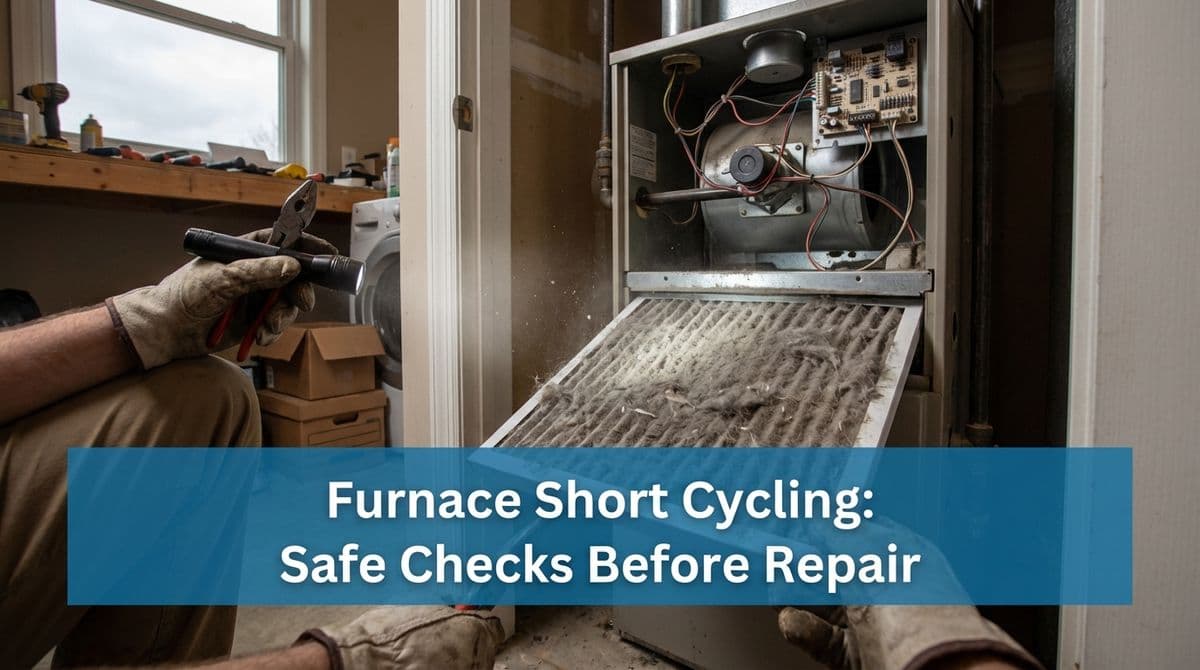
When Your Furnace Won’t Stay On: A Call That Hit Close to Home
We recently got a call from a worried customer — let’s call him Jason — whose mom lives about 40 minutes away from him. He told us her furnace was running a lot, shutting off, and then starting right back up again. The house was warm enough for the moment, but the furnace wouldn’t hit the set temperature and kept short cycling.
To make matters more stressful, it was heading into a cold night, her usual HVAC company wasn’t picking up, and she was home alone. Jason was afraid the furnace would quit overnight and the pipes might freeze. That mix of worry, distance, and cold weather is something we hear a lot this time of year.
On the phone with Jason, we walked through a couple of simple, safe checks his mom could try before paying anyone to come out — the same things we’re going to walk you through here.
What Is Furnace Short Cycling, Exactly?
Short cycling is when your furnace:
- Starts up
- Runs for a short time
- Shuts off before reaching the thermostat set point
- Starts up again soon after
In Jason’s case, the indoor temperature was still above 70°F, so the furnace was heating, just not efficiently or consistently. That’s typical of short cycling — the system is working, but something is causing it to shut down early and restart over and over.
Left alone, short cycling can lead to higher gas and electric bills, uneven temperatures, and extra wear and tear on your furnace components.
Two Very Common Causes: Dirty Filters and Flame Sensors
When we hear a story like Jason’s, a couple of usual suspects jump to the top of our list:
- Dirty air filter
- Dirty or faulty flame sensor
Here’s why those matter.
1. Dirty Furnace Filter
This is the one we always start with. We asked Jason when his mom last changed her filter. He said, “She told me last month.” We gently told him what we’ll tell you: we never fully trust that answer without checking.
A clogged filter restricts airflow across the heat exchanger. When that happens, the furnace can overheat. There’s a safety sensor (a high-limit switch) that monitors temperature. If it gets too hot, the switch shuts the burner down to protect the furnace. Once it cools, the furnace will try again — and you get that short cycling behavior.
This is why we told Jason, and we’ll tell you: the very first thing to do is change the filter. It’s cheap, safe, and often fixes the problem on the spot.
2. Dirty Flame Sensor
The flame sensor is a small metal rod that “proves” there’s a flame when the furnace is running. Over time, it can build up carbon and oxidation. When it gets too coated, it can’t properly sense the flame.
When that happens, the control board thinks there’s no flame, shuts the gas off for safety, then tries again. This can cause short cycling as well, but it tends to look a bit different than an overheating issue.
We mentioned this possibility to Jason, but we were very clear: cleaning a flame sensor is not something we recommend homeowners do on their own. You have to remove panels, sometimes bypass safety switches to access it, and work near gas controls. That’s where it’s better to wait for a professional.
Safe Checks You Can Do Before Calling for Furnace Repair
Here are the same homeowner-safe steps we walked Jason through for his mom. These are things you can try without opening up the furnace or handling gas components.
Step 1: Replace the Furnace Filter (Don’t Just Look at It)
Even if you’re sure you “just changed it,” go ahead and replace it anyway. We’ve pulled out plenty of filters that were supposedly changed “last month” and were clearly a year old.
How to safely do it:
- Turn the thermostat to “Off” so the furnace doesn’t start while you’re working.
- Locate the filter slot — usually in the return air duct or inside the blower compartment door.
- Slide the old filter out and note the size printed on the frame.
- Install a new filter of the same size, with the airflow arrow pointing toward the furnace.
- Turn the thermostat back to “Heat” and see how the furnace behaves over the next hour or so.
If the filter was the culprit, you’ll usually notice longer, steadier run cycles and the furnace actually reaching the set temperature.
Step 2: Try a Simple Power Reset
For Jason’s mom, we also suggested a basic reset if the furnace happened to shut down completely at some point.
Here’s the safe way to do that:
- Find the furnace power switch — it often looks like a regular light switch mounted near or on the furnace.
- Switch it Off and wait about 1–2 minutes.
- Switch it back On and let the furnace go through its start-up sequence.
Sometimes, this clears a temporary fault or hiccup in the control board. If the furnace fires back up and runs normally afterward, you may be in the clear — but if it continues to short cycle, you’ll still want a technician to look for the underlying cause.
When to Stop DIY and Call a Professional
After we talked through these steps, Jason felt better about waiting until the next day for his mom’s regular HVAC company — as long as the house stayed warm and the furnace still cycled on.
As a general rule, it’s time to call a pro if:
- You’ve replaced the filter and the furnace still short cycles.
- The furnace won’t light at all, or the burners light and shut off within seconds.
- You smell gas or burning odors (shut everything down and leave the house if you smell gas).
- The furnace is making strange noises — banging, screeching, or loud rattling.
- You’re not comfortable doing even basic checks — that’s okay; that’s what we’re here for.
Preventing Short Cycling Before It Starts
We always tell homeowners that the easiest furnace problems to fix are the ones you never get in the first place. A few simple habits go a long way:
- Change your filter regularly — every 1–3 months, depending on filter type, pets, and dust.
- Schedule annual maintenance so a technician can clean the flame sensor, check safety controls, and inspect the heat exchanger.
- Keep supply and return vents unblocked by furniture, rugs, or curtains.
If your furnace is short cycling and you’re worried about it keeping up overnight, start with the safe checks above. And if it still doesn’t seem right after a fresh filter and a reset, reach out — we’d rather talk you through it and catch an issue early than have you lose heat on the coldest night of the year.