Why Is My AC Freezing? R-22 Systems & Repair vs Replace
Frozen AC lines, an old R-22 system, and no cool air? Learn what causes freeze-ups, what R-22 means for repair costs, and when it makes sense to replace your system.
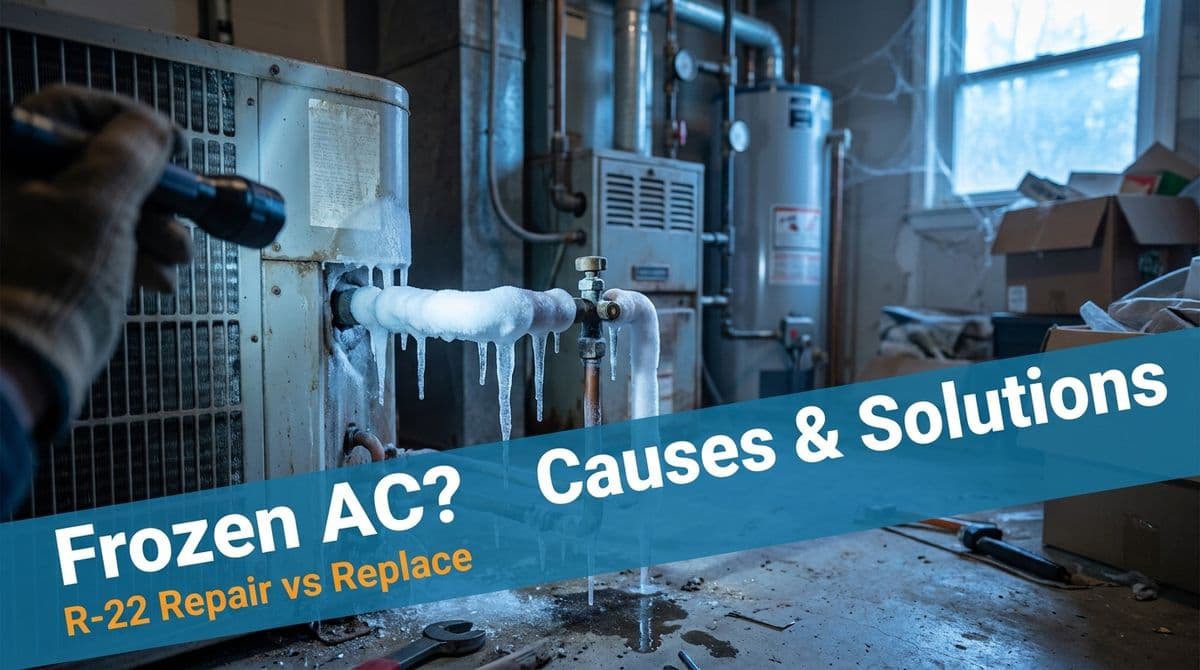
When Your AC Is a Block of Ice: A Real Call We Just Ran
We recently got a call from a homeowner — let’s call her Linda — who was worried she’d accidentally used our emergency line. Her air conditioner had suddenly stopped cooling, and when she went downstairs, she saw two long pipes completely frozen over. Thick ice, no cool air, and a lot of stress.
As we talked with Linda, she mentioned something else important: her system runs on R-22 refrigerant, and a few years back another company had told her it was “that expensive kind of freon.” She was really hoping she wouldn’t have to replace the whole system, but she was also worried about the cost of more R-22.
We scheduled a visit, came out to her home, checked the outdoor unit and the furnace, and confirmed what we suspected on the phone: low refrigerant had caused the system to freeze up. Once we got eyes on everything, we could walk her through her options — repair versus replace — in plain English and real numbers, not guesswork.
Why AC Systems Freeze: More Than Just “It’s Hot Outside”
A frozen air conditioner usually means something has thrown off the balance of airflow or refrigerant. Ice looks like a “too cold” problem, but it’s usually a not enough problem — not enough air or not enough refrigerant.
When we see ice on the refrigerant lines (those “two long pipes” Linda noticed), we typically start by checking these common causes:
- Low refrigerant charge – From a leak or an undercharged system. This was Linda’s situation, and it’s especially common on older R-22 units.
- Restricted airflow – A dirty filter, closed supply vents, blocked returns, or a clogged evaporator coil can all cause the coil to get too cold and freeze.
- Blower or fan issues – If the indoor blower motor or the outdoor fan isn’t moving enough air, the temperature across the coil can drop below freezing.
- Thermostat or control problems – A system that runs nonstop because of a bad thermostat or control board can eventually freeze up.
One of the first things we asked Linda was, “When was the last time you changed your air filter?” She told us she swaps it out about once a month and had just replaced it a week earlier. That let us rule out the simplest airflow issue right away and focus on refrigerant and mechanical checks.
How Low Refrigerant (Especially R-22) Leads to Ice
Refrigerant is what carries heat from inside your home to the outside. When the system is low, pressures drop, and the evaporator coil can get colder than it should. Moisture in the air freezes on the coil and the lines, building more and more ice until airflow is choked off and the system stops cooling altogether.
On older systems that use R-22, a leak is more than just a performance problem — it’s a financial decision point. R-22 has been phased out, so:
- It’s no longer produced in the U.S.
- Supplies are limited, so the price has climbed sharply.
- Every recharge is money into a system that’s already near the end of its life.
When we told Linda that her system was low on R-22 and that topping it off would be expensive, we also explained that if there’s a leak, the refrigerant will eventually leak back out. Adding more without addressing the leak is usually just a temporary bandage.
R-22 Systems: When a Repair Still Makes Sense
We never like to tell anyone, “You need a new system” unless we’re confident replacement really is the smarter move. With R-22 units, we usually walk through a few key questions:
- How old is the system? If it’s under about 10 years and in otherwise good shape, a targeted repair might be worth it.
- How big is the leak? Small, repairable leaks in accessible spots can sometimes be fixed cost-effectively.
- How often has it needed refrigerant? If you’re adding R-22 every season or every other season, that’s a red flag.
- What’s your budget and timeframe? Some homeowners, like Linda, need a few days to move money around. In those cases, we talk about short-term vs. long-term options.
In some situations, a one-time R-22 recharge to get you through the rest of the season — while you plan and budget for replacement — can be a reasonable short-term plan. The key is going into it with eyes open, understanding that you’re investing in a system you’ll eventually replace.
When It’s Time to Replace Instead of Repair
There comes a point where pouring more money into an R-22 system just isn’t in your best interest. We’re usually upfront about recommending replacement when:
- The unit is 12–15+ years old and has already needed multiple repairs.
- The cost of the repair plus R-22 is a big chunk of what a new, high-efficiency system would cost.
- Parts are getting harder to find, or multiple components are showing their age.
- Energy bills are high because the system is inefficient and running long cycles.
With a modern system that uses today’s refrigerants, you get:
- Lower energy use and utility bills.
- Readily available refrigerant and parts.
- Manufacturer warranties for peace of mind.
When we talked through the numbers with Linda, we laid out both paths: what it would cost to chase the R-22 issue and what a replacement would look like. Our goal is always to help you make the decision that fits your home, your budget, and your comfort — not just for today, but over the next 5–10 years.
What to Do Right Now If Your AC Is Frozen
If you walk downstairs and see icy pipes like Linda did, there are a few steps you can safely take before we arrive:
- Turn your thermostat to “Off.” This stops the cooling cycle so the system can start to thaw.
- Switch the fan setting to “On.” Running just the indoor fan (no cooling) helps melt the ice faster.
- Check your air filter. If it’s dirty, replace it. A clogged filter alone can cause a freeze-up.
- Open all supply and return vents. Make sure none are blocked by furniture, rugs, or closed manually.
Give the system several hours to completely thaw — sometimes overnight. Trying to run it while there’s still ice on the coil or lines can damage the compressor. Once we arrive, we’ll check refrigerant levels, inspect for leaks, verify airflow, and test electrical and mechanical components so you’re not left guessing.
How to Prevent Future Freeze-Ups
While not every freeze-up can be prevented, a few simple habits dramatically reduce the chances:
- Change filters regularly. For most homes, that’s every 1–3 months. Linda does this monthly, which is great.
- Keep vents and returns clear. Don’t block them with furniture, curtains, or storage boxes.
- Schedule annual maintenance. A professional tune-up lets us catch weak blower motors, dirty coils, and low refrigerant before they become emergencies.
- Listen for changes. New noises, longer run times, or uneven cooling are all early warning signs.
We’d much rather meet you for a routine check than for a hot-house emergency with ice-covered pipes. Regular care keeps your AC running smoother, lowers your bills, and gives you more time to plan for replacement when the day eventually comes.
If your AC is frozen, you have an older R-22 system, or you’re simply not sure which direction to go, we’re happy to come out, take a look, and give you honest options — whether that’s a quick fix, a short-term bandage, or a full system upgrade.